work - Oct to Dec 2025
Crit group at Yorkshire ArtSpace, Exchange Place Studios, Sheffield
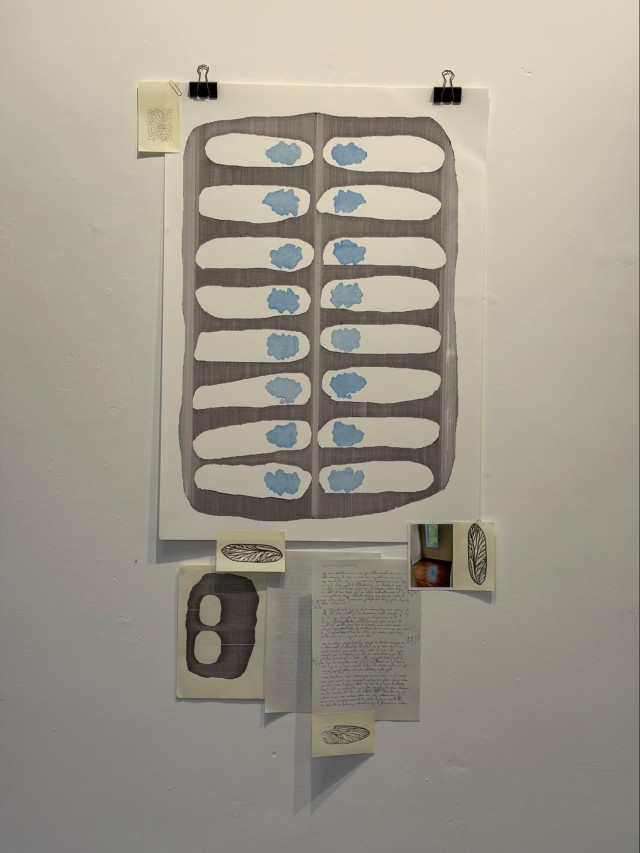
ootheca[provisional] biro on paper
20 attendees
30mins people study and talk about the work - no context - the artist is not allowed to speak
15mins questions and discussion with artist
The installation occupied two adjoining walls. On one side, the Brownie wall gathered together a constellation of objects and references: the original camera mounted on a small shelf, several 3D-printed spools fitted with wings, and a handful of turned-over photographs taken with my childhood Brownie. A single spool with its winged paper strip perched on the shelf, echoing other stray spools that had “escaped” into different parts of the room. Nearby hung a photograph of the Brownie in situ and a drawing of the same and a large definition of brownie. Two small photographs of an empty room extended the sense of absence and interiority.
The adjacent wall presented the text and glyph drawings: sheets of evolving experiments with text blocks, annotations, and asemic mark-making — a kind of ongoing study of writing systems themselves. Above the table of drawings hung a large ootheca drawing as a visual bridge between the 2 displays.
I also included a printed sheet of Brownie definitions and a copy of The Pregnant Hopper, though the latter was largely overlooked.
At these crits it happens quite often that one section will get a lot more interest than another section of the presentation and I thought providing 2 quite distinct areas might be an interesting exercise. It’s a group of about 20 people and they don’t like moving about.
Discussion and responses tended to orbit the text drawings. People were intrigued by their ambiguity — unsure whether they were hand-drawn or computer-generated. They provoked curiosity and a sense of sampling, as if the viewer were at a buffet of possible readings. From a distance the works resembled text; up close they revealed notation, code, or even a shorthand for something just out of reach.
Comments clustered around ideas of language and data: the drawings as systems that strip information down, revealing structures rather than content. Some saw them as simultaneously didactic and obfuscating — attempts to grasp something withheld, or to express meaning through concealment. The work was described as mad ramblings, liminal language, romantic, and even comforting in its abstraction. Questions of scale arose: could these A4 sheets expand to fill a room? Others noticed how the marginalia and post-its implied rethinking and revision, as if the work were still in progress.
Several viewers touched on authorship and agency: whether the marks were human, beyond human, or a kind of polyphonic conversation between artist, text, and machine. The work was seen as both a critique of information overload and an echo of technological literacy — a counter-cultural play with form and saturation. One person read the biro references as a commentary on passive consumption, the empty pen as a relic of writing itself. (I placed 2 empty biros on the table with the text pieces)
The Brownie work received less attention, though those who engaged with it read it as an investigation of an alien being on equal terms, its taxonomy cellular rather than digital. The sticky notes suggested an ongoing inquiry into the unseen and the unseeable, an analogue to quantum observation. Some saw pairs and bisections throughout — human and nonhuman, visible and invisible. The Brownie was described as a helper, a presence in dark corners, an analogue imaging system with the fluttering/shuttering eyes of an insect.
The definition of ‘brownie’ — dusty attic, domestic helper, half-imagined creature — was rarely read, confirming my sense that placement and orientation determine attention in a group setting. I had divided the work between two walls knowing that focus would likely fall unevenly, but the split felt productive: one wall about systems of language, the other about the more intimate, mythical apparatus that underpins them.
It was interesting to note that most people were unaware of the history of the brownie camera - it’s not as iconic as I thought it might be - a lot of references fall short for a good number of the audience - like the ubiquitous nature of the brownie - and like the biro - cheap, accessible, functional.