the black line and the cockroach
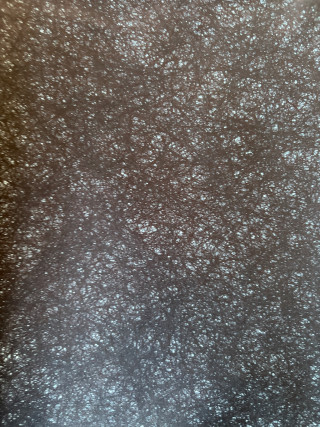
a persistant line in black biro that fills a page
The black line promises certainty. It announces itself as depth, as closure, as an agreement between intention and material. Yet when it is laid down, it refuses that contract. A pink sheen surfaces in the ink, a chromatic excess that unsettles the claim of blackness. The line is no longer obedient. It becomes a site of friction.
This sheen is not decorative. It interferes with judgement. What should be neutral reveals itself as contingent, angled, biased. The discomfort arises precisely because the drawing is doing what it is meant to do, while also disclosing what drawing cannot control. Material asserts its own conditions, its own history, its own way of catching the light.
The irritation is instructive. It exposes how aesthetic preference often operates as a demand for compliance. We want black to remain black because it stabilises the image, confirms authority, sustains a hierarchy of tones. When the ink resists, it reveals the fragility of that hierarchy. The drawing no longer reassures. It insists on being encountered.
Working with this line requires endurance rather than resolution. The task is not to correct the sheen or to refine it away, but to remain present to its disturbance. In doing so, drawing shifts from an act of control to one of coexistence. The line continues, not because it satisfies taste, but because it exposes how taste itself is formed.
The presence of the cockroach in our work operates in a similar register. It is not there to symbolise abjection or to provoke shock, but to insist on a form of attention that resists refinement. Like the sheen in the ink, the cockroach refuses assimilation into a clean aesthetic logic. Its body is too specific, too materially insistent. It disrupts scale, comfort, and distance. You cannot easily stand back from it without simplifying it into metaphor, and that simplification is precisely what the work resists. The cockroach brings the drawing into contact with something that cannot be beautified without loss. It exposes the limits of aesthetic preference in the same way the pink-black line does, by making visible the tension between what is wanted and what persists.
In this encounter, drawing becomes a practice of staying with what unsettles judgement.
The line and the insect share a demand for endurance, for proximity without resolution. Both ask for a way of working that allows disturbance to remain active, shaping the drawing from within rather than being smoothed away.
The Passion According to GH/JH/MAL